

Go and Do Likewise
On image-bearers, strangers, why love for people is never wasted

For Your Monday - February 23, 2026.
When my wife and I went on our first date in college, I remember spending much of our four-hour coffee shop conversation talking about our families.
“How many siblings do you have?”
“Are you close with your grandparents?”
“Where did your family come from?”
Much of getting to know someone is getting to know the stories of their own beloved someones. It’s automatic. The questions of “who are you?” and “where do you come from?” are rarely answered in the abstract. We often answer them by talking about people at some point in the story.
We are people people. The stories of our loved ones become our stories. We are entangled together in the grand journey of life. The fact that we talk about people so much tells us something important, something foundational to the way we experience life, as designed by the Creator.
It starts at the very beginning. In Genesis 1, after sky and sea and creature and tree, God creates people in His own image. “Let us make mankind in our image, in our likeness,” He says, and then He does. And when He steps back and looks at everything He has made, He calls it very good.
We are image-bearers. This means every person you have ever passed in a hallway, sat next to on a plane, or scrolled past without a second thought carries something of God in them. That is not a small thing, and God has never treated it as one.
When His people are suffering under the weight of slavery in Egypt, He doesn’t observe from a distance. In Exodus 3, He says, “I have indeed seen the misery of my people. I have heard them crying out. I am concerned about their suffering.” The three verbs in this passage, seen, heard, and concerned, tell you everything about the kind of God we’re dealing with. He is not indifferent. He is not unmoved. He is a God who pays close attention to His people, who leans in rather than away.
Then, Jesus appears and tells us of a love for people that is even more personal and sometimes uncomfortable.
In Luke 10, a lawyer asks Him a question that sounds theological but is really quite practical: ‘Who is my neighbor?’ Jesus doesn’t give an out-of-the-book definition. He tells a story of a man beaten and left on the side of the road, passed over by the religious and respectable. The hero of the story is a Samaritan, someone a Jewish audience would have found deeply difficult to admire. Jews and Samaritans had a centuries-long history of ethnic and religious tension between them. It was cultural awkwardness at best, ingrained hostility at worst. Jesus plants this man at the center of the story as the one who sees, hears, and does something out of his concern. Jesus turns the question back around: “Which of these three do you think was a neighbor to the man who fell into the hands of robbers?” The answer is obvious. The neighbor is whoever stops to help. The neighbor is the one who shows mercy.
Go and do likewise, Jesus says.
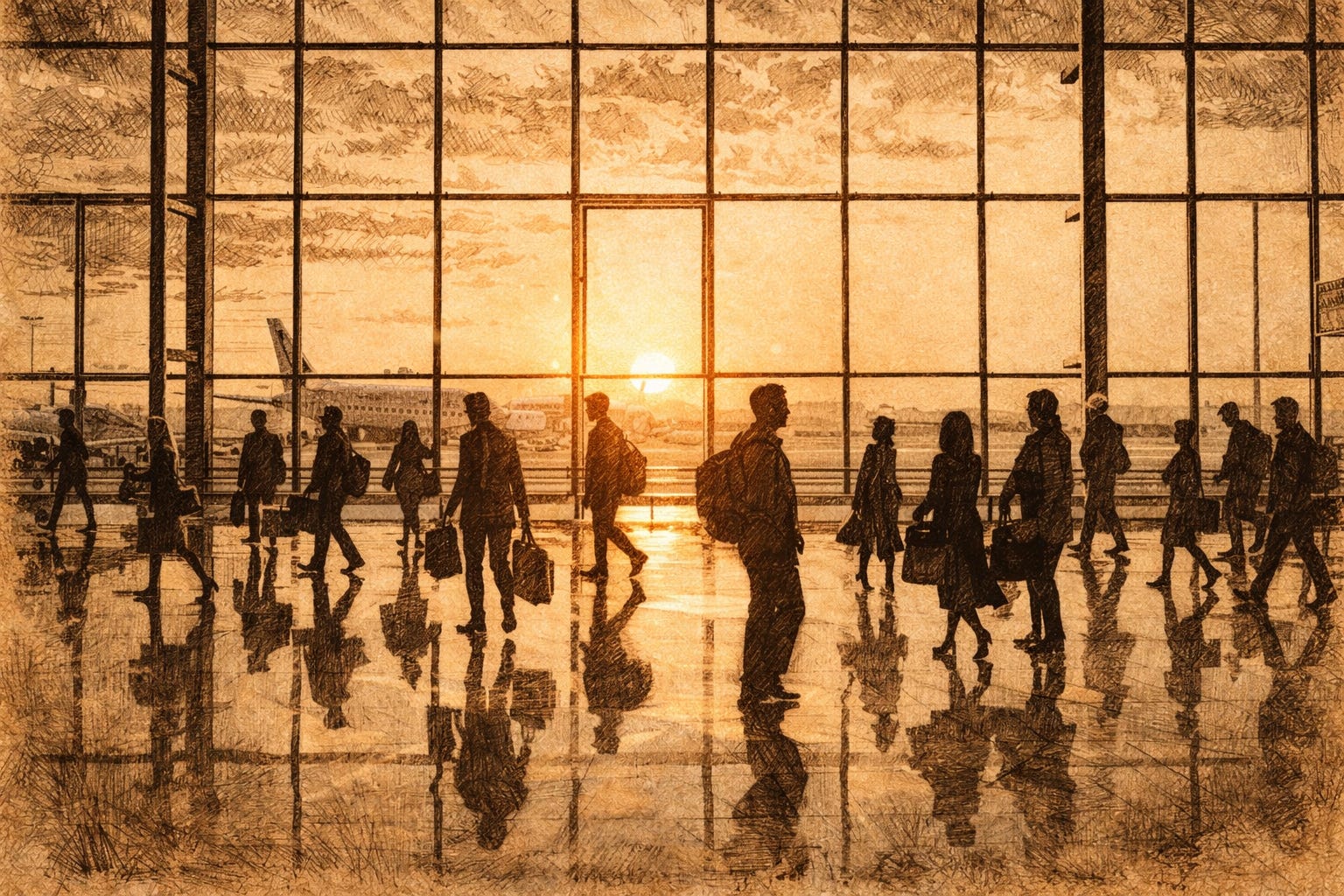
What’s funny is, I started writing this in an airport terminal, of all places. Airports are a fascinating place to test whether you actually love people to this degree or not. There are hundreds of others here, all going somewhere, all carrying something, all image-bearers, whether they know it or not.
It’s one thing to believe that people matter. It’s another thing entirely to act like it when you’re tired and delayed and someone is eating something that smells like it came from a different century.
It’s places like this where the theology has to actually land, or it’s just theory.
What does it actually look like to be a people person in the way God is?
It might look like being genuinely gracious to the person next to you on your next flight, because they’re carrying something you can’t see. It might look like being generous again to someone who has taken advantage of your generosity before, not because it’s easy, but because you’ve been on the receiving end of a grace that wasn’t easy either. It might look like training your mind to think the best of a person when you first meet them, rather than subconsciously making them earn your kindness before you offer it.
None of this is natural. It’s called formation, and luckily, the way has been paved by a suffering servant who lived and died to save the people He desperately loves. Jesus of Nazareth.
It was after the creation of people when God looked at all He had made and called it very good. That’s not a footnote. That’s the whole point.
Tomorrow, I’ll be in airport terminals again, and I wonder how easy or difficult it will be to love people. May we all remember the person in front of you is not an interruption. They are the point.
Until next time,
May the Lord bless the work of your hands, guide the thoughts of your mind, and complete His own work in the deepest part of your heart.